Enhanced Oil Recovery: More Oil from the Same Reservoir
Lesson Summary
Thermal, gas, and chemical recovery methods, and when to use them after primary and secondary stages.
This lesson is part of the Production & Processing track and is 7:21 minutes long. Watch the video first, then review the key points and test your understanding with the questions below.
Key Points
- 1Thermal recovery lowers heavy oil viscosity
- 2Gas injection displaces oil or mixes with it
- 3Chemical recovery changes surface tension or water viscosity
Written Lesson
Why does oil remain in the reservoir?
Even after years of production, a large portion of the original oil remains in the reservoir because it is trapped in rock pores by capillary forces and interfacial tension, or it is too viscous to move, or it is in areas bypassed by displacement. Therefore, a field's success is measured not just by what it has produced, but by the recovery factor relative to the total oil in place.
Recovery is divided into three stages: Primary (Primary), relying on natural reservoir energy and artificial lift; Secondary (Secondary), maintaining pressure through water or gas injection; and Tertiary or Enhanced (EOR), which alters the properties of the oil or the displacing fluid to extract more. Typically, primary recovery captures a small percentage of original oil, secondary adds more, and EOR adds an additional percentage that varies greatly by reservoir.
The Core Concept: Mobility Ratio
Displacement success depends on the Mobility Ratio (M): M = (relative water permeability ÷ water viscosity) ÷ (relative oil permeability ÷ oil viscosity). When M is greater than 1, the displacing fluid tends to bypass the oil through "fingering."
Calculated example with illustrative values: relative water permeability 0.3 and viscosity 1 cp, relative oil permeability 0.8 and viscosity 20 cp. Thus, M = (0.3 ÷ 1) ÷ (0.8 ÷ 20) = 0.3 ÷ 0.04 = 7.5, indicating poor displacement. If a polymer is added to increase water viscosity to 10 cp, then M = (0.3 ÷ 10) ÷ 0.04 = 0.75, resulting in a more stable displacement. This is the core concept of polymer flooding.
Types of EOR Techniques
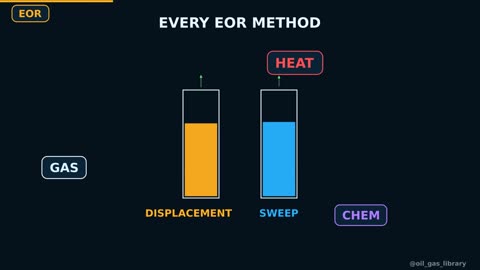
- Thermal: Steam injection to heat heavy oil and lower its viscosity, including cyclic steam, steam flooding, and SAGD; and In-Situ Combustion, which generates heat and gases within the formation.
- Gas: Injection of CO₂, hydrocarbon gas, or nitrogen. Under the right conditions, the gas becomes miscible with the oil, reducing its viscosity and surface tension, or displaces it immiscibly.
- Chemical: Polymers to increase water viscosity and improve sweep efficiency, surfactants, and alkalis that react with natural acids in the oil to form surfactants in-situ; these may be combined in ASP flooding.
How to Choose?
Not every technique is suitable for every reservoir. Selection depends on oil viscosity and density, rock type and permeability, temperature, pressure, depth, water salinity, resource availability (steam, gas, or water), and economic feasibility. As a general rule: heavy, viscous oil often suits thermal methods; light or medium oil at sufficient depth suits gas injection; and when water displacement is poor due to high viscosity, polymer flooding is a candidate.
Fields typically follow a sequence: laboratory studies on samples, then simulation, then a pilot test in a small area, followed by expansion if results are achieved.
Challenges
- Cost: Building steam plants or sourcing gas and polymers is expensive.
- Containment and Leakage: Injected fluids may take paths that bypass the oil.
- Corrosion and management of produced water and gases.
- Environmental impact and energy/water consumption, especially in thermal methods.
The figures and values in this lesson are for educational purposes; every case requires a detailed reservoir study before a decision.