Why does production tubing get choked by wax? All about paraffin
Lesson Summary
When oil temperature drops below the wax appearance point, crystals begin depositing on the wall. Causes, detection, prevention, and removal.
This lesson is part of the Production & Processing track and lasts 10:01 minutes. Watch the video first, then review the key points and test your understanding with the questions below.
Key Points
- 1Wax Appearance Temperature (WAT) is the critical threshold
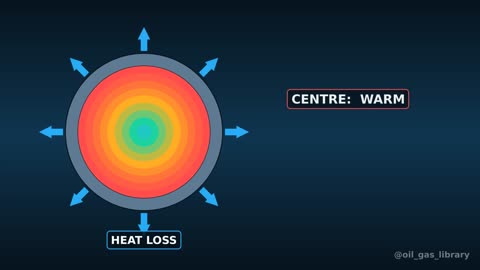
- 2Heat loss toward the surface causes deposition
- 3Removal is mechanical, thermal, or chemical
- 4Inhibitors reduce deposition but do not prevent it entirely
Written Lesson
What is wax in oil?
Crude oil is a mixture of many compounds, including long hydrocarbon chains called paraffins (Paraffins or n-Alkanes). At reservoir temperature, they are fully dissolved in the oil, but as the oil cools during its ascent, their solubility decreases, and they begin to emerge as solid crystals. The first temperature at which these crystals appear is called the Wax Appearance Temperature (WAT), or sometimes the Cloud Point. There is another lower temperature called the Pour Point, below which the oil stops flowing under gravity because the crystal network has locked it in place.
How does wax deposit on the wall?
Deposition does not occur equally everywhere. The tubing or pipeline wall is colder than the oil flowing in the center, so crystals form at the wall first. The temperature difference between the flow center and the wall causes dissolved wax molecules to move toward the wall—a mechanism called Molecular Diffusion—forming a layer that thickens and hardens over time. Therefore, deposition is concentrated where the oil cools: in the upper tubing, at the wellhead, in flowlines, and especially in subsea lines cooled by seawater.
Worked Example: A well with a reservoir temperature of 200°F at 10,000 ft, and a flowing wellhead oil temperature of 90°F; assuming temperature changes linearly with depth in the tubing. If the oil's WAT is 110°F, the depth where the temperature reaches 110°F is 10,000 × (110 − 90) ÷ (200 − 90) = 10,000 × 20 ÷ 110 ≈ 1,820 ft from surface. Deposition is expected in the top 1,800 ft of the tubing, where treatment should be focused.
Why is it dangerous for production?
The wax layer narrows the pipe diameter, increasing friction and decreasing production, potentially plugging the pipe entirely. It also hinders slickline tool operations and may prevent the subsurface safety valve from functioning properly.
Calculated example: Tubing size 2-7/8 in has an ID of 2.441 in. A wax layer 0.25 in thick reduces the diameter to 2.441 − 2 × 0.25 = 1.941 in. The remaining area ratio is (1.941 ÷ 2.441)² ≈ 0.63, meaning a quarter-inch of wax resulted in a loss of about 37% of the flow area.
How to detect the problem?
- Gradual production decline with an increase in the pressure differential between bottomhole and wellhead.
- Increase in flowline pressure at the same flow rate.
- Difficulty lowering slickline tools, and the gauge cutter stopping at a certain depth and returning covered in wax.
- In the lab: Measuring WAT, pour point, and wax content in the oil; these data should be available before production design.
Prevention
- Heat maintenance: Insulating flowlines, heating, or increasing production rates because faster flow loses relatively less heat.
- Chemical Wax Inhibitors and crystal modifiers: These change crystal shapes to reduce their ability to adhere and interlock. They are injected continuously, often via a Chemical Injection Line below the deposition zone.
- Pour Point Depressants: Important for transportation lines and restarting after shutdowns.
Inhibitors reduce deposition but do not prevent it entirely, so a removal method is always planned.
Removal
- Mechanical: A Scraper or Gauge Cutter lowered via slickline to scrape the tubing, and Pigs in pipelines.
- Thermal: Pumping hot oil or hot water (Hot Oiling) to melt the wax. Caution: Hot oiling can push melted wax into the formation if not properly designed.
- Chemical: Aromatic solvents like xylene dissolve wax, often used with a Soaking period.
- Via Coiled Tubing: Washing with solvent or hot water using jetting nozzles in difficult cases.
Wax vs. Asphaltenes and Hydrates
Wax is related to temperature drops, whereas Asphaltenes are often linked to changes in pressure and oil composition, and Hydrates are water crystals trapping gas at low temperatures and high pressures. All are Flow Assurance issues, but their treatments differ; thus, the deposit type must be identified by sample analysis before choosing a remedy.
Summary
- Wax deposits when oil temperature drops below its appearance point, starting at the cold wall.
- Deposition is concentrated in the upper tubing and flowlines.
- Prevention via heat and inhibitors; removal via mechanical, thermal, or chemical methods.
- Identify the deposit type through analysis: wax is different from asphaltenes and hydrates.
The figures and examples in this lesson are for educational purposes. On the job, always follow your company procedures and accredited training center instructions.
Test Yourself
Lesson Glossary
The highest temperature at which wax crystals begin to appear in the oil.
The lowest temperature at which oil remains capable of flowing.
A chemical that reduces wax deposition and modifies its crystal shape.
Pumping hot oil or water to melt deposited wax.
Prevention of deposits and blockages that hinder the flow of fluids from the reservoir to the facilities.
Temperature at which paraffin wax crystals begin to form.