Inside the separator: how are gas, oil, and water separated?
Lesson Summary
A journey inside the three-phase separator: inlet device, settling section, Mist Extractor, Weir, and level and pressure control.
This lesson is part of the Production & Processing track and lasts 10:01 minutes. Watch the video first, then review the key points and test your understanding with the questions below.
Key Points
- 1Separation depends on density difference and time
- 2The inlet device breaks momentum and begins separation
- 3The Mist Extractor traps mist before the gas outlet
- 4The Weir separates oil from water
Written Lesson
What does the separator do?
What comes out of the well is not pure oil, but a mixture of gas, oil, and water, and sometimes sand. The separator (Separator) is the first piece of equipment in the processing plant to separate these three phases from each other: gas goes to the gas line, oil to tanks or further treatment, and water to water treatment.
Separation depends on three things: the density difference between phases, gravity which pulls the heavier ones down, and sufficient time for gravity to act. In some designs, centrifugal force (Cyclonic) is added to speed up the process.
Basic Components
- Feed pipe (Feed Pipe) and inlet device (Inlet Device): they break the momentum of the mixture and begin primary separation. Types include Diverter Plate, Half-Pipe, Vane Inlet, and Cyclonic Inlet.
- Gas gravity section (Gas Gravity Section): a space that allows liquid droplets to fall out of the gas stream.
- Mist extractor (Mist Extractor): captures fine droplets that did not settle; types include Wire Mesh, Vane Pack, and Cyclones.
- Liquid gravity section (Liquid Gravity Section): provides the oil and water with the residence time needed to separate.
- Outlets: a gas outlet at the top, an oil outlet, a water outlet, and a sand outlet in some designs.
Terminal Velocity and the Souders-Brown Equation
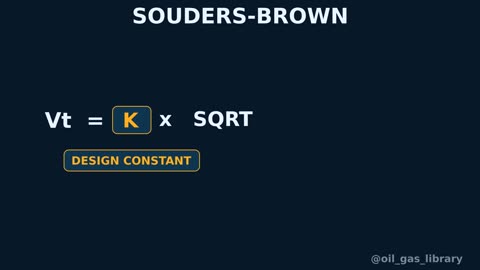
A liquid droplet falls through gas at a terminal velocity (Terminal Velocity) depending on its size and density. For simplicity, the Souders-Brown equation is used to estimate the maximum allowable gas velocity (Vmax) in the separation section, which is the velocity above which gas carries droplets away instead of letting them fall: Vmax = K × √((ρl − ρg) ÷ ρg), where ρl is liquid density, ρg is gas density, and K is a constant that varies by type and pressure.
Calculated example with reference values: K ≈ 0.35 ft/s with a mesh-type extractor at low pressures, liquid density 50 lb/ft³, and gas density 1.5 lb/ft³. The allowable velocity ≈ 0.35 × √(48.5 ÷ 1.5) ≈ 0.35 × 5.69 ≈ 2.0 ft/s. If the actual gas flow is 3 ft³/s, the required cross-sectional area ≈ 3 ÷ 2.0 = 1.5 ft², meaning a diameter of at least about 16.6 inches.
The K value is a reference and changes with pressure and extractor type; it should be taken from approved design standards.
Retention Time (Retention Time)
For oil to separate from water, the liquid needs sufficient retention time inside the separator. Liquid volume = flow rate × retention time. If the oil flow is 5,000 bbl/d and the retention time is 3 minutes, the required volume = 5,000 ÷ 1,440 × 3 ≈ 10.4 bbl.
The required time varies based on oil density, viscosity, and temperature: light oil separates faster, while heavy viscous oil needs more time. For oil-water separation, baffles such as the Weir, Bucket, and Boot are used.
Control and Protection
The separator has control systems to maintain its pressure and level: a Level Controller adjusts the liquid level, a Back Pressure Valve regulates gas pressure, a PSV safety valve opens if pressure exceeds the limit, and sensors like PSH and LSH alarm and shut down at high limits. These protections are specified in the API RP 14C standard.
What happens if the liquid level rises above the limit? Liquid is carried over with the gas into the next line (Carry-over), which can damage the compressor. Therefore, the high-level sensor is a critical protection.
Separator Types and Common Problems
Types include: Vertical separator (suitable for high gas and low liquid volumes, saves space), Horizontal (suitable for high liquid volumes and oil-water separation), Spherical, and the Scrubber for removing liquid traces from gas.
- Foam (Foam): reduces separation efficiency and causes Carry-over.
- Paraffin (Paraffin): accumulates and clogs internal parts.
- Sand: accumulates, reduces capacity, and leads to erosion.
- Corrosion: weakens the separator walls and components.
- Sloshing (Sloshing): affects level measurement in mobile separators.
- Carry-under: gas escaping with the liquid, and Carry-over: liquid escaping with the gas.
The numbers in this lesson are for learning purposes; actual design values are taken from your company's design standards and manufacturer data.
Test Yourself
Lesson Glossary
Vessel that separates gas, oil, and water by gravity differences.
Captures liquid droplets prior to the gas outlet.