One Meter Perforation Error Ruins the Well: How do GR and CCL work?
Lesson Summary
We use GR to identify formations and CCL to count casing joints, precisely setting the perforation gun depth.
This lesson is part of the Formation Evaluation track and is 10:00 minutes long. Watch the video first, then review the key points and test your understanding with the questions below.
Key Points
- 1The CCL detects collars as electrical pulses
- 2The GR correlates depth with the open-hole log
- 3Known joint lengths provide a depth reference
Written Lesson
Why does one meter matter?
Before perforating, we must know the exact depth of the producing formation inside the closed steel casing. A one-meter error could place the shots in a shale layer, a water zone, or miss part of the oil. We need two tools working together: Gamma Ray (GR) and Casing Collar Locator (CCL).
What is Gamma Ray?
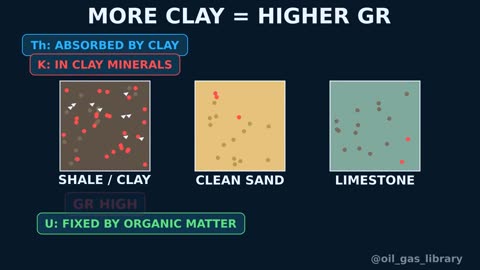
Rocks contain naturally radioactive elements: potassium, thorium, and uranium, which are more abundant in shale than in clean sand and carbonates. The GR tool measures this radiation with a scintillation detector; the reading increases in shale and decreases in sand.
The reading is measured in API units, referenced to the API Calibration Pit at the University of Houston, established to standardize readings across companies.
Shale volume Vsh can be estimated: first the GR index: IGR = (GR − GRmin) ÷ (GRmax − GRmin). Illustrative example: GRmin = 20, GRmax = 120, and the reading is 70, so IGR = 50 ÷ 100 = 0.5. Using the Larionov equation for older rocks: Vsh = 0.33 × (2^(2 × IGR) − 1) = 0.33 × (2 − 1) = 0.33, or about 33%. For younger rocks (Tertiary), the equation is: Vsh = 0.083 × (2^(3.7 × IGR) − 1) ≈ 0.22, or about 22%. These values are illustrative and vary by field.
What is a CCL?
The casing consists of joints connected by couplings called collars; at each collar, the metal mass increases slightly. The CCL tool contains a coil and a magnet; as it passes a collar, the magnetic field changes, generating an electrical pulse that appears as a peak on the log. We count the collars to determine our position relative to the casing string.
Since joint lengths are known from the casing tally, the CCL provides an accurate depth reference. A short joint at a known location is often used as a distinctive marker.
The Tie-In and Setting Perforation Depth
We run a tool string with GR and CCL inside the cased hole, record the GR at a specific speed, and then compare the GR log from the casing with the previous GR log from the open hole. By matching characteristic peaks and valleys, we find the depth difference between the two logs.
Explanatory example: we find that the cased-hole log is deeper than the open-hole log by 10 ft at the same formation, so we correct the depth by 10 ft. Afterwards, we use the CCL to locate collar connections near the target depth and perforate relative to a known reference collar.
Note: Radiation inside casing is attenuated by steel and cement, so absolute values will be lower than in open hole; therefore, we compare the shape and pattern rather than numerical values.
Errors to Avoid
- Failing to stabilize logging speed or having variable cable speed, which shifts depths.
- Comparing absolute values instead of log patterns.
- Forgetting to tie-in depths between the open-hole and cased-hole logs.
- Relying on a single nearby collar without verifying the total collar count.
The numbers in this lesson are illustrative, and tool specifications vary by manufacturer.
Test Yourself
Lesson Glossary
Cemented pipe strings that protect the borehole wall and isolate formations.
Detects casing collars for precise depth correlation.