Hydraulic Fracturing: From Tight Rock to Flowback
Lesson Summary
We pump fluid at a pressure exceeding fracture pressure to open cracks in the rock, then fill them with proppant to keep them open.
This lesson is part of the Drilling & Completion track and is 8:11 minutes long. Watch the video first, then review the key points and test your understanding with the questions below.
Key Points
- 1The fracture opens perpendicular to the minimum horizontal stress (Shmin)
- 2Proppant keeps the fracture open after pumping stops
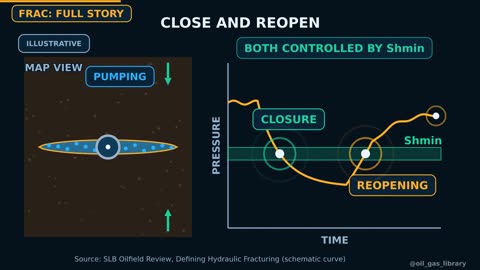
- 3Closure pressure is approximately equal to Shmin
- 4Flowback recovers the fracturing fluid
Written Lesson
Why do we fracture the rock?
In tight rocks and shale, permeability is so low that oil or gas cannot move toward the well at an economic rate, regardless of reservoir pressure. Hydraulic fracturing creates cracks that act as highways connecting a larger rock surface area to the well, thereby increasing production.
Rock Mechanics: Where does the fracture open?
Subsurface rock is compressed by three stresses: vertical, minimum horizontal Shmin, and maximum horizontal SHmax. The fracture opens perpendicular to the least stress, meaning it aligns with the maximum stress. In most deep reservoirs, the minimum stress is horizontal, so the fracture opens vertically; at shallow depths, vertical stress may be the minimum, causing the fracture to open horizontally.
The Closure Pressure is close to Shmin, representing the minimum pressure inside the fracture to keep it open. Net Pressure = Pressure inside fracture − Closure pressure; this is what drives fracture growth.
Well Preparation
The process requires a sound wellbore: reliable casing and cement, as pressures are very high. The casing is tested above expected pressure, then the well is perforated in stages using the Plug & Perf method: a perforation gun and plug are run, a section is perforated, the plug is set to isolate the stage for pumping, and the process is repeated for the next section.
Fracturing Fleet (Frac Spread)
- The Blender: Mixes water, sand, and chemical additives.
- High-pressure pumps: Provide the necessary hydraulic horsepower.
- The Manifold and high-pressure iron piping.
- Water tanks and sand (proppant) storage.
- The Data Van: Monitors pressure, rate, and sand concentration in real-time.
Calculation example: a well with a vertical depth of 10,000 ft and a fracture gradient of 0.8 psi/ft, giving a fracturing pressure at depth of ≈ 8,000 psi. Water hydrostatic pressure ≈ 0.433 × 10,000 = 4,330 psi. Assuming friction losses in the tubing and perforations around 1,500 psi, surface treating pressure ≈ 8,000 − 4,330 + 1,500 ≈ 5,170 psi.
Hydraulic horsepower is calculated: HHP = Rate (bbl/min) × Pressure (psi) ÷ 40.8. At a rate of 80 bbl/min and pressure of 5,170 psi, the power ≈ 80 × 5,170 ÷ 40.8 ≈ 10,137 HHP, a massive amount of power distributed across multiple pumps.
Fracturing Fluid and Pumping Stages
The fluid is mostly water and sand (the vast majority of the volume), with the remainder being additives: friction reducers, biocides, thickeners, and scale inhibitors. The recipe varies from well to well.
- Acid: Cleaning perforations and opening flow paths.
- The Pad: Sand-free fluid that initially opens and grows the fracture.
- Proppant Stages: Sand is added with gradually increasing concentration.
- The Flush: Displaces remaining sand from the wellbore and ends the stage.
Inside the Fracture and Beyond
When pumping stops, the fracture closes onto the proppant, which keeps it open. Some fluid leaks off into the rock (leakoff), then closure begins. We monitor net pressure, and sometimes microseismic monitoring is used to estimate fracture extent.
Next comes the flowback: the well is opened to allow part of the fracturing fluid to return to the surface, then production begins. These fluids are treated and managed carefully to protect the environment.
Safety
Very high pressures in the lines, risks from pressurized iron, silica dust from sand, chemicals, and water management. The operation is performed according to an approved program and permits, with defined exclusion zones during pumping. Numbers in this lesson are illustrative.
Test Yourself
Lesson Glossary
Granular material that holds fractures open after hydraulic fracturing.