Well anatomy: from wellhead to bottomhole
Lesson Summary
A tour inside the well: Casing with its overlapping diameters, cement, Tubing, Packer, wellhead, and Christmas Tree.
This lesson is part of the Drilling & Completion track, with a duration of 10:01 minutes. Watch the video first, then review the key points and test your understanding with the questions below.
Key Points
- 1Casing protects the wellbore walls and isolates formations.
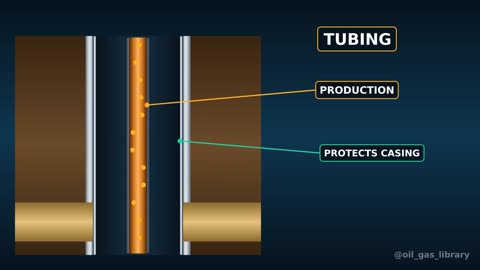
- 2Tubing carries production to the surface.
- 3Packer isolates the Annulus from production.
- 4The wellhead suspends the pipes and controls flow.
Written Lesson
A Tour Inside the Well
A well is not just a hole in the ground as it appears from the outside, but an integrated system of pipes, cement, and equipment run in a carefully planned sequence. Understanding this arrangement is the foundation for reading any wellbore schematic and discussing completion or maintenance.
The Casing: Overlapping Strings
Casing strings are run in stages, each stage with a smaller diameter than the previous one, making the well look like an inverted telescope. Their names vary according to their function:
- Conductor: The first and largest diameter string, it stabilizes loose surface formations and guides the mud at the start.
- Surface Casing: Protects freshwater aquifers and provides a foundation for installing the BOPs.
- Intermediate Casing: Isolates troublesome zones or different pressure regimes before reaching the reservoir.
- Production Casing: Reaches or crosses the reservoir, forming the wall inside which production equipment is installed.
- Liner: A short string suspended from the end of the previous casing that does not extend to the surface, saving costs.
Common diameter sequence example: 20 inches, then 13-3/8, then 9-5/8, then 7 inches, but each well's sequence is determined by depth and the formations encountered.
Cement Behind the Casing
After running each string, part or all of it is cemented; the cement becomes the wall that bonds the Casing to the rock and isolates formations. If this sheath is defective, problems arise such as annular pressure (Annulus) or gas migration.
The Tubing and Packer
Inside the Production Casing, the smaller diameter Tubing is run to carry oil or gas to the surface. The reason for using tubing rather than the Casing itself is that Tubing can be pulled and replaced more cheaply, and it protects the Casing from production corrosion and pressure.
The Packer is a tool set near the bottom of the Tubing that seals the annulus between it and the Casing, so that pressure and fluids remain only inside the Tubing, and the Casing is not directly exposed to formation pressure. In the Tubing much higher up, at a depth relatively close to the surface, the Subsurface Safety Valve (SSSV) is installed to automatically shut in the well if surface control is lost.
Wellhead and Christmas Tree
The Wellhead is the structure that suspends the Casing and Tubing strings at the surface, containing ports to measure and control pressure in each annulus. Above it sits the Christmas Tree, a set of valves that control the well's flow:
- Master Valve: The most critical valve, it shuts in the well completely.
- Wing Valve: Opens the flow path to the production line.
- Swab Valve: At the top of the tree, it allows vertical access to the well for running Wireline or Coiled Tubing tools through a Lubricator rigged up and tested above it.
- Choke: Adjusts the flow rate and surface pressure.
Summary
A sound well is a series of successive barriers: cement, Casing, Tubing, Packer, and tree valves. Each barrier protects the next. Understanding these parts and their order explains why each is tested, and why operations stop if unexpected pressure appears in any annulus.
Test Yourself
Lesson Glossary
Cemented pipe strings that protect the borehole wall and isolate formations.
Conduit through which produced fluids flow to the surface.
Isolates the annulus from the production conduit.
Assembly of valves installed on the wellhead to control production.