BOP Equipment: Types and Closure Methods
Lesson Summary
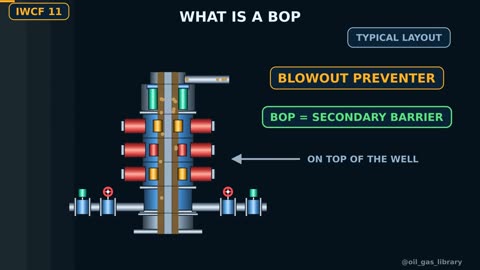
The BOP is the second barrier. We cover the Annular, Pipe Rams, Blind/Shear Rams, Choke and Kill lines, and allowable pressure calculations.
This lesson is from the Well Control track, and lasts 11:24 minutes. Watch the video first, then review the key points and test your understanding with the questions below.
Key Points
- 1The Annular closes on various shapes and diameters
- 2The Pipe Ram closes on the pipe body, not on the Tool Joint
- 3The Blind/Shear rams cut the pipe and shut in the well
- 4The Stack pressure rating must exceed the MASP
Written Lesson
The Annular Preventer (Annular Preventer)
It consists of a rubber packing element reinforced with steel fingers (Packing Element), pushed upward and inward by a hydraulic piston to close around the pipe, Kelly, Tool Joint, or even cables. Its flexibility makes it the first choice when shutting in during many procedures, and it allows stripping pipes slowly while the well is under pressure (Stripping) if its closing pressure is carefully adjusted. However, the rubber element wears out, and it is usually recommended not to close it on an open hole unless necessary. Closing pressure is adjusted per manufacturer instructions and pipe size.
Types of Rams
- The Pipe Rams: their packing is molded to a specific pipe diameter, so they close on the pipe body only, not on the wider Tool Joint.
- The Variable Bore Rams (VBR): they close on a range of diameters, useful when using multiple pipe sizes in the well.
- The Blind Rams: a flat surface that shuts in the well when nothing is in it.
- The Shear Rams and Blind/Shear Rams: blades that cut the pipe body and then shut in the well. They do not normally cut Drill Collars or Tool Joints, so the driller must know the position of the connections relative to the Rams, which is called space-out.
The Rams are designed so that well pressure from below helps keep them closed, so they hold pressure from one direction only and must be installed in the correct direction. They feature manual or automatic (Ram Locks) that keep them closed even if hydraulic pressure is lost.
Closing Ratio (Closing Ratio)
The closing ratio is the ratio of well pressure the Ram can overcome to the hydraulic pressure required to close it, and comes from the piston area compared to the Ram shaft area exposed to well pressure.
Required closing pressure = Wellbore pressure ÷ Closing ratio
Calculated example: A ram with a closing ratio of 7:1 and an expected well pressure of 10,000 psi. The required hydraulic pressure is 10,000 ÷ 7 ≈ 1,429 psi, which is lower than the usual operating pressure of 1,500 psi on the manifold. However, if the ratio were 6:1, we would need 10,000 ÷ 6 ≈ 1,667 psi, which is greater than 1,500 psi, meaning the operating pressure for this component must be increased per the manufacturer's instructions.
Stack arrangement and outlets
There is no single mandatory arrangement; rather, it is chosen based on well risks and company policy. A common onshore example from top to bottom: the annular preventer, then Pipe Rams, then Blind/Shear Rams, then the Drilling Spool with the Choke and Kill outlets, then lower Pipe Rams. The important thing is to know exactly what can be closed below any outlet, and which Ram can be used if another leaks. On the Choke line there is a hydraulically operated valve (HCR) opened remotely, and manual valves upstream of it.
Pressure Rating and MASP
Each component has a Rated Working Pressure (Rated Working Pressure) such as 5,000, 10,000, or 15,000 psi. The entire Stack rating must be higher than the maximum anticipated surface pressure (MASP). One of the most conservative methods for estimating MASP is to assume the well is filled with gas to the surface.
MASP (gas to surface) = Pf − Gas gradient × TVD
Calculated example: A formation with a pressure of 8,000 psi at a vertical depth of 12,000 ft, and a gas gradient towards 0.1 psi/ft. Maximum surface pressure ≈ 8,000 − 0.1 × 12,000 = 8,000 − 1,200 = 6,800 psi. Any Stack rated at 5,000 psi is not enough, and we need a Stack of at least 10,000 psi. Formation leak-off pressure at the shoe is also used in design, as it may be the actual limit for surface pressure.
The Choke Manifold and Surface Equipment
The choke manifold receives well fluids from the choke line and features adjustable manual or hydraulic chokes to control backpressure on the well during kill operations. The mud and gas then flow into a mud gas separator (or poor boy degasser), where gas is separated and vented or routed to the flare line. The gas handling capacity of this separator is a critical component of well control design.
Summary
- The annular preventer is flexible and seals around various shapes, while pipe rams seal on the pipe body only.
- Shear rams require proper space-out because they typically cannot cut tool joints or drill collars.
- The closing ratio determines the hydraulic pressure required to close the ram against a given well pressure.
- The stack pressure rating must exceed the calculated MASP.
The figures and examples in this lesson are for educational purposes. On the job, always follow your company procedures and accredited training center instructions.
Test Yourself
Lesson Glossary
The reinforced rubber element in the annular preventer that seals around the pipe.
Pipe rams designed to seal on a range of pipe diameters.
Ensuring the ram closes or cuts on the pipe body and not across a tool joint.
The ratio of well pressure to the hydraulic pressure required to close the ram.
The pressure that the stack must withstand under the worst-case scenario.
Wellhead valve assembly used to shut in the well in the event of a kick.
Rams designed to seal around a specific pipe diameter.
Shear through the pipe and fully shut in the wellbore.
An orifice that controls flow rate and creates a pressure drop.