Warning Signs: How to Detect a Kick Early
Lesson Summary
Faster detection means a smaller Kick. We distinguish between positive indicators like pit gain and flow with pumps off, and possible signs like a Drilling Break.
This lesson is part of the Well Control track and is 12:25 minutes long. Watch the video first, then review the key points and test your understanding with the quiz below.
Key Points
- 1Increase in pit volume (Pit Gain) is a positive indicator
- 2Increase in return flow rate with constant pump rate
- 3Well flowing with pumps off = check and shut-in
- 4Drilling Break is a possible sign, not proof
Written Lesson
Why speed is everything?
Every minute that passes before a Kick is detected means additional barrels of formation fluids inside the well. A larger Kick means higher shut-in pressures, greater stress on the Casing shoe, and a more difficult kill operation. This is why well control training distinguishes between two types of signs: positive indicators (Positive Indicators) meaning the well is flowing and must be shut in, and warning signs (Warning Signs) meaning something has changed and must be checked.
Positive Indicators
- Increase in mud pit volume (Pit Gain) without adding mud from the surface: every barrel entering from the formation pushes a barrel of mud into the pits.
- Increase in return mud rate (Return Flow) with constant pumping rate: the Flow Show indicator on the Flowline reads higher than pump output.
- Well flowing with pumps stopped: this is the clearest sign, detected by a flow check (Flow Check).
- During trips: the well takes less mud than calculated when pulling out, or returns more mud than the pipe displacement when running in.
As soon as any positive indicator appears, do not hesitate: shut in the well according to the rig's approved procedure, then read the pressures calmly.
Warning Signs
- The Drilling Break: a sudden increase in drilling speed, which may mean entering a more porous or higher-pressure formation.
- Decrease in pump pressure with an increase in pump strokes: light fluid in the Annulus reduces the pressure required for circulation. However, the cause could also be a pipe Washout, so check.
- Increase in gas readings, appearance of connection gas, and gas-cut mud.
- Change in cuttings shape and size, increase in torque and drag.
- Change in return mud temperature or salinity.
A warning sign alone is not proof, but ignoring it is the start of most incidents. The correct response is to perform a flow check.
Flow Check Step-by-Step
1. Stop drilling and lift the bit off bottom to a position that allows closing the Rams away from a tool joint.
2. Stop the pumps.
3. Observe the well directly at the Flowline or via the trip tank for a sufficient duration specified by rig procedures, which is longer in oil-based mud because gas can dissolve in it.
4. If the well flows, shut it in immediately. If it does not flow, record the result and continue cautiously while monitoring the pits.
The Ballooning phenomenon can deceive the crew: formations take mud during circulation and return it when pumps stop. Differentiating this from a Kick is difficult; the safe rule is to treat any flow as a Kick until proven otherwise.
Why does a small volume make a difference?
The height of the Influx in the Annulus is what determines the difference between the two shut-in pressures. The larger the volume, the longer the light fluid column, and the higher the SICP will be.
Influx height (ft) = Pit gain (bbl) ÷ Annular capacity (bbl/ft)
SICP − SIDPP ≈ (Mud gradient − Influx gradient) × Influx height
Calculated Example: 8-1/2 in hole with Drill Collars diameter 6-1/2 in: Annulus capacity equals (8.5² − 6.5²) ÷ 1,029.4 = 30 ÷ 1,029.4 ≈ 0.0291 bbl/ft. A 10 bbl gas Kick occupies 10 ÷ 0.0291 ≈ 344 ft. With 10 ppg mud (gradient 0.52 psi/ft) and gas gradient around 0.1 psi/ft, the difference is (0.52 − 0.1) × 344 ≈ 144 psi. If we delayed until the volume reached 20 bbl, the height would double to about 688 ft and the difference to about 289 psi, all of which is added to the Casing shoe pressure.
Role of Instruments and Role of Humans
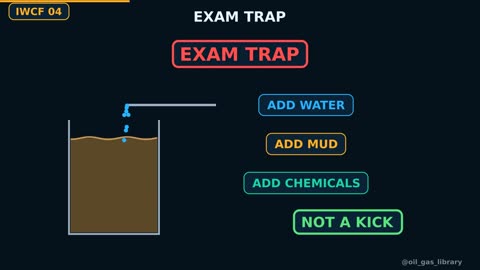
The PVT systems monitor pit volumes and trigger an alarm when a limit set by the well program is exceeded, just as the Flowline indicator measures return flow. But instruments need someone to read them: the driller must know what is happening on the surface, such as mud transfers between pits or chemical additions, so as not to confuse a normal volume change with a real Kick. Communication between the driller, mud engineer, and Mud Logging team is part of the barrier itself.
Summary
- Positive indicators: pit gain, increased returns, well flowing with pumps off, and trip volume discrepancies.
- Warning signs require a flow check, not negligence.
- Every additional barrel increases SICP and pressure on the Casing shoe.
- Early detection is teamwork: accurate instruments and a crew aware of surface operations.
The figures and examples in this lesson are for educational purposes. On the job, always follow your company procedures and accredited training center instructions.
Test Yourself
Lesson Glossary
An increase in mud volume in the pits without surface addition, a positive indicator of a Kick.
Stopping the pumps and monitoring the well to see if it flows on its own.
A sudden increase in rate of penetration (ROP), a possible sign of formation or pressure change.
Instruments that measure mud volume in the pits and trigger an alarm if it changes.
Mud loss during circulation and return when stopped, appearing similar to a Kick.
Influx of formation fluids into the wellbore when bottomhole pressure falls below formation pore pressure.