Well Pressure Fundamentals
Lesson Summary
Everything in well control starts with pressure. We learn about hydrostatic pressure, gradient, and why we use True Vertical Depth TVD instead of Measured Depth MD.
This lesson is part of the Well Control track and is 21:43 minutes long. Watch the video first, then review the key points and test your understanding with the questions below.
Key Points
- 1Hydrostatic Pressure (psi) = 0.052 × Mud Weight (ppg) × TVD (ft)
- 2Gradient (psi/ft) = 0.052 × Mud Weight
- 3Pressure follows the vertical height of the column, not the well length
- 4Mud window: higher than pore pressure and lower than fracture pressure
Written Lesson
Why start with pressure?
Every decision in drilling and well control ultimately comes down to one question: is the pressure inside the wellbore greater or less than the formation pressure? If it is greater by a safe margin, the well remains stable; if it falls below, formation fluids enter the well and a Kick begins. This is why every well control curriculum, including IWCF, starts with understanding pressure before any equipment or procedures.
Pressure is the force acting on a unit of area, and we measure it in the field in psi or bar. Three pressures matter to us in the well: mud column pressure, formation pressure (pore pressure), and formation fracture pressure. Between the latter two lies the window in which the mud weight must operate.
Hydrostatic Pressure
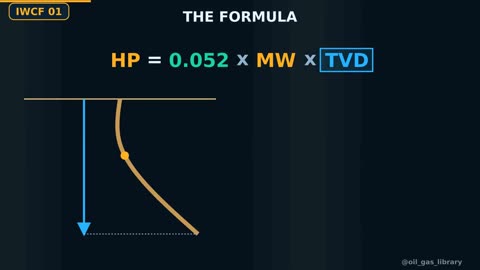
A column of any static liquid exerts pressure on what is below it due to its weight alone, and is not affected by the hole shape or diameter. The equation in field units is:
Hydrostatic Pressure (psi) = 0.052 × Mud Weight (ppg) × True Vertical Depth TVD (ft)
The number 0.052 is a unit conversion constant that converts ppg and ft to psi: a cubic foot contains about 7.48 gallons, and the area of a square foot is 144 square inches, and 7.48 ÷ 144 ≈ 0.052. Thus, it has nothing to do with the weight of water itself. In metric units, we use: Pressure (bar) = 0.0981 × Density (SG) × TVD (m).
Calculated example in field units: Mud weight 10 ppg and vertical depth 10,000 ft, the bottomhole pressure will be 0.052 × 10 × 10,000 = 5,200 psi. Metric example: Density 1.25 SG and vertical depth 2,500 m, the pressure will be 0.0981 × 1.25 × 2,500 ≈ 306.6 bar.
Gradient: Pressure per Foot
The gradient (Gradient) simplifies calculations; it is simply the pressure added by each foot of depth: Gradient (psi/ft) = 0.052 × Mud Weight. Thus, fresh water weighing 8.33 ppg has a gradient of about 0.433 psi/ft, and salt water in sedimentary formations has a natural gradient close to 0.465 psi/ft, which is equivalent to about 8.9 ppg.
The gradient helps us compare different weights quickly: a 12 ppg mud has a gradient of 0.624 psi/ft, so every thousand feet of depth increases the pressure by 624 psi.
The MD and TVD Trap
Measured Depth MD is the length of the pipes inside the hole, while True Vertical Depth TVD is the vertical distance from the surface to the point. Hydrostatic pressure follows the vertical height of the column only, so we never use MD in its equation.
Example: A deviated well has a measured depth of 12,500 ft and a vertical depth of 9,800 ft, and the mud weight is 10 ppg. The correct calculation is 0.052 × 10 × 9,800 = 5,096 psi. If we mistakenly used MD, we would get 6,500 psi, an imaginary increase of 1,404 psi. This specific mistake is one of the most common errors made by trainees in exams.
Formation Pressure, Fracture Pressure, and Mud Window
Formation pressure (Formation Pressure or Pore Pressure) is the pressure of fluids inside the rock pores. If the mud column pressure is higher, we are in an Overbalance condition, which is the required safe state. If it falls below, the well becomes Underbalanced and formation fluids may enter.
On the other hand, fracture pressure (Fracture Pressure) is the pressure at which the formation breaks and starts leaking mud into it. If the mud is too heavy, the rock fractures and losses (Losses) occur, the mud level in the well drops, reducing the hydrostatic pressure, which may lead to a Kick.
The area between pore pressure and fracture pressure is the operating window (Operating Window). In deep or abnormal pressure wells, this window narrows, and every 0.1 ppg becomes critical.
Key Takeaways
- Hydrostatic Pressure = 0.052 × Mud Weight × TVD; MD and well diameter are not included.
- Gradient = 0.052 × Mud Weight, which simplifies weight comparison.
- We want the mud column pressure to be higher than the pore pressure by a calculated margin, and lower than the fracture pressure.
- Any change in mud weight or vertical depth means recalculating from scratch.
Notice
The numbers in this lesson and its examples are for educational and illustrative purposes. In actual operations, always refer to your company procedures and the instructions of your accredited training center.
Test Yourself
Lesson Glossary
Pressure exerted by a static column of fluid, depending on its density and vertical height.
Vertical distance from surface to a given point; used for all pressure calculations.
Length of the wellbore along its trajectory; used for calculating volumes and tubular lengths.