Gas Migration in a Shut-in Well
Lesson Summary
A gas bubble rising in a shut-in well carries its pressure with it, increasing surface and bottomhole pressures. Learn how to read the trend and when to use the volumetric method. Gas migration well control IWCF
This lesson is part of the Well Control track and is 11:22 minutes long. Watch the video first, then review the key points and test your understanding with the questions below.
Key Points
- 1In a shut-in well, gas does not expand, so pressure increases throughout the entire well
- 2The simultaneous rise of SIDPP and SICP over time is a sign of migration
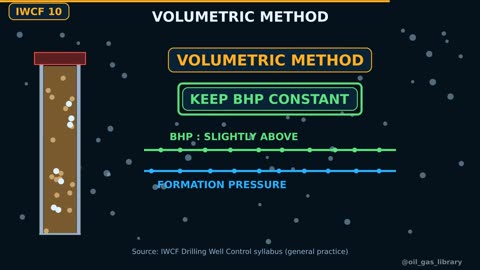
- 3Volumetric Method: Bleeding off a calculated volume of mud to keep bottomhole pressure constant
- 4Never leave a shut-in well unmonitored
Written Lesson
What happens to a gas bubble in a shut-in well?
Gas is much lighter than mud, so it rises in the annulus even when the well is shut-in and pumps are stopped. This is Gas Migration. In an open well, gas expands as it rises because the surrounding pressure decreases. However, in a shut-in well filled with nearly incompressible mud, the gas finds no room to expand. According to Boyle's Law, if volume does not change and temperature remains relatively constant, pressure stays constant. This means the bubble carries the bottomhole pressure it entered with as it rises to the surface.
The result is that pressure increases at every point in the well: the mud column below the bubble lengthens, adding its weight to the bubble's pressure on the bottom and the casing shoe, while the mud column above it shortens, causing surface pressure to rise.
P(surface) ≈ P(bubble) − 0.052 × MW × depth of bubble
P(bottom) ≈ P(bubble) + 0.052 × MW × (TVD − depth of bubble)
Calculated Example: A well with a TVD of 10,000 ft, mud weight of 10 ppg, and formation pressure of 5,720 psi (meaning SIDPP = 520 psi). A small bubble enters and the well is shut-in; neglecting the bubble's own length: if it rises to 5,000 ft without expanding, its pressure remains 5,720 psi. The bottomhole pressure becomes 5,720 + 0.052 × 10 × 5,000 = 5,720 + 2,600 = 8,320 psi, and the surface pressure becomes 5,720 − 2,600 = 3,120 psi. Pressure of this magnitude would likely fracture the formation at the casing shoe before the bubble reaches the surface. This is an extreme theoretical case, but it explains why we do not leave a shut-in well unmonitored.
How do we know gas is migrating?
The primary sign is the rise of SIDPP and SICP together by approximately the same amount over time after they have stabilized following shut-in. We record pressures at regular intervals, as the trend is more important than a single reading. The gas migration rate can be estimated from the rate of pressure increase.
Migration rate (ft/hr) ≈ Pressure rise (psi/hr) ÷ Mud gradient (psi/ft)
Calculated Example: SICP increased by 100 psi in one hour, and the mud is 10 ppg (gradient 0.52 psi/ft). The approximate migration rate is 100 ÷ 0.52 ≈ 192 ft/hr.
The rate varies greatly depending on mud type, viscosity, and well inclination. In oil-based mud (OBM), part of the gas dissolves under pressure, so migration may not appear as clearly; the gas then suddenly breaks out of solution near the surface, requiring extra caution.
When do we need the Volumetric Method?
The best solution is to circulate and remove the gas using standard kill methods. However, sometimes circulation is impossible: pipe out of hole, plugged bit, pipe off bottom above the kick, or pump failure. In these cases, we use the Volumetric Method: we allow the gas to expand in a calculated manner by bleeding mud through the choke, while keeping bottomhole pressure constant and above formation pressure with a safety margin.
Steps of the Volumetric Method
1. Select a Safety Margin and a Working Pressure increment, e.g., 100 psi each.
2. Calculate the mud volume equivalent to the working pressure increment in the annulus.
3. Allow casing pressure to rise by the safety margin and working pressure increment combined.
4. Slowly bleed mud through the choke while keeping casing pressure constant until the calculated volume is collected in the trip tank.
5. Shut in and allow pressure to rise by another working pressure increment, repeating until gas reaches the surface, then begin the Lubrication phase to remove it and replace it with mud.
V (bbl) = Pw (psi) × Annular capacity (bbl/ft) ÷ Mud gradient (psi/ft)
Calculated Example: The annulus between an 8-1/2 in hole and 5 in pipe has a capacity of (8.5² − 5²) ÷ 1,029.4 = 47.25 ÷ 1,029.4 ≈ 0.0459 bbl/ft. For a 100 psi working pressure and 0.52 psi/ft mud: V = 100 × 0.0459 ÷ 0.52 ≈ 8.8 bbl. This means in each cycle, we bleed only about 8.8 bbl while keeping casing pressure constant.
Common Errors
- Bleeding mud without calculation to "relieve" pressure: every barrel removed without calculation reduces bottomhole pressure, causing a second kick.
- Allowing pressure to rise without limit: this may fracture the formation at the shoe, turning the situation into an underground blowout.
- Relying on a single reading: we need a chronological log of pressures and volumes.
If pipe is in the hole without a float valve, it is preferable to rely on SIDPP: bleed through the choke such that drill pipe pressure remains constant at its original value plus the safety margin.
Summary
- In a shut-in well, gas rises carrying its pressure, so surface, bottomhole, and shoe pressures all rise together.
- The simultaneous rise of SIDPP and SICP over time is a sign of migration, and the rate of increase gives an approximate velocity.
- If circulation is impossible, use the Volumetric Method: bleeding a calculated volume while keeping bottomhole pressure constant.
- Do not bleed without calculation, and do not let pressure rise without limit.
The figures and examples in this lesson are for educational purposes. On the job, always follow your company procedures and accredited training center instructions.
Test Yourself
Lesson Glossary
The product of pressure and volume is constant for a given mass of gas at a constant temperature.
Pumping mud into the well and bleeding off gas in stages after it reaches the surface.
Uncontrolled flow from one formation to another within the wellbore.
Drill string pressure measured after shut-in, used to calculate formation pressure and kill mud weight.
Pressure in the annulus after shut-in, directly affected by the type and volume of the influx.
Upward movement of gas in a shut-in well, carrying its pressure toward the surface.
Bleeding off calculated mud volumes to maintain constant bottomhole pressure during gas migration.