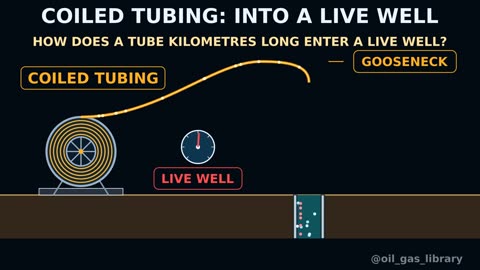
Coiled Tubing 1: From Reel to Bottomhole
Lesson Summary
A continuous steel tube miles long deployed into a live well under pressure without killing it. Definition, history, system overview, and comparison with jointed pipe and wireline.
This lesson is part of the Well Intervention track, with a duration of 10:01 minutes. Watch the video first, review the key points, and test your understanding with the quiz below.
Key Points
- 1Continuous tubing on a reel with no connection joints
- 2Continuous pumping capability while tripping
- 3Operates in live wells under pressure
- 4Limitations: fatigue life, rotation, and horizontal reach
Written Lesson
What is Coiled Tubing?
Coiled Tubing (CT) is a continuous, jointless steel pipe wound on a large reel and run into or pulled out of the well using an injector head. Outer diameters typically range from 1 in to around 2-7/8 in, with string lengths on a single reel reaching several thousand feet. Since the 1960s, CT technology has evolved into one of the most critical tools in well intervention.
What Makes It Unique?
- No joints: Eliminates screwing and unscrewing pipe every 30 ft as with jointed pipe, resulting in significantly faster trip times.
- Pump while moving: The tubing is hollow and connected to pumps through a swivel joint on the reel core, enabling fluid circulation while tripping in or out.
- Work under pressure (live well): Deployed through a stripper and dedicated BOP stack, eliminating the need to kill the well with heavy mud that could damage the reservoir.
- Reach in deviated and horizontal wells: Its mechanical rigidity allows it to be pushed downhole, unlike wireline which relies on gravity.
System Overview
A CT unit consists of the reel, gooseneck guide, injector head that grips and drives the tubing with chain blocks, pressure control equipment (stripper and BOP), control cabin, and hydraulic power unit (power pack). The appropriate BHA for the intervention is made up at the bottom of the string. Subsequent lessons in this series cover each component in detail.
Quick Comparison
- Vs. Jointed Pipe: CT provides faster trip times and operates on live wells, but jointed pipe supports much higher tensile loads, torque, and full surface rotation.
- Vs. Slickline & E-line: Wireline is faster and more cost-effective for simple tasks, but cannot circulate fluids or push tools. CT adds fluid circulation and pushing force.
- Vs. Snubbing unit: Snubbing handles heavy jointed pipe under pressure and higher capacities, but is slower in execution.
Operational Limits to Consider
- Fatigue life: The tubing undergoes plastic bending with every trip over the reel and gooseneck, consuming a portion of its fatigue life.
- Rotation: The CT string cannot be rotated from surface. Downhole rotation requires a mud motor (Mud Motor) in the BHA.
- Buckling and Lock-up: In long horizontal wells, friction causes the tubing to buckle helically until forward movement stops (lock-up). Solution options include larger tubing sizes, friction reducers, or downhole tractors.
- Pressure and tension limits: Determined by steel grade, wall thickness, and pipe condition, loads must strictly stay within the safe operating envelope.
Internal Tubing Volume
Due to the length and small inner diameter, the internal capacity dictates the time required for any fluid or drop ball to reach bottomhole.
Capacity (bbl/ft) = ID² (in) ÷ 1,029.4
Calculated Example: For a tubing string with an outer diameter of 1.75 in and a wall thickness of 0.134 in, the inner diameter is 1.75 − 2 × 0.134 = 1.482 in. Capacity calculation: 1.482² ÷ 1,029.4 = 2.196 ÷ 1,029.4 ≈ 0.00213 bbl/ft. If the total length on the reel is 15,000 ft, total string volume is 15,000 × 0.00213 ≈ 32 bbl. At a pump rate of 1.5 bbl/min, fluid takes roughly 32 ÷ 1.5 ≈ 21 minutes to reach the end of the string. Note that this calculation accounts for the entire reel length, not just the section downhole.
Applications
Wellbore cleanout of sand and scale, nitrogen lifting, acidizing, milling, fishing, logging and perforating in horizontal wells, setting plugs, and sometimes CT drilling. All of this is often done without pulling the production tubing.
Summary
- The CT is a continuous pipe that allows pumping while moving and operates in a live well.
- Its components: the reel, the gooseneck, the injector head, pressure control equipment, control cabin, and power pack.
- Its main limits: fatigue, lack of rotation, and lock-up in horizontal wells.
- The internal volume is calculated for the entire pipe on the reel.
The figures and examples in this lesson are for educational purposes. On the job, always follow your company procedures and accredited training center instructions.
Test Yourself
Lesson Glossary
The device that pushes the pipe into the well and pulls it out using gripper chains.
A well that has surface pressure and has not been killed with heavy mud.
The point where the pipe can no longer advance into the well due to helical buckling and friction.
A motor in the BHA driven by fluid flow to rotate the bit or milling tool.
Continuous length of steel tubing spooled on a reel, deployed into live wells without making pipe connections.
Conduit through which produced fluids flow to the surface.