Coiled Tubing 6: What can Coiled Tubing do in the well?
Lesson Summary
Most common operations: cleanout, nitrogen lift, acidizing, scale removal, and milling.
This lesson is part of the Well Intervention track, with a duration of 10:01 minutes. Watch the video first, review the key points, and test your understanding with the quiz below.
Key Points
- 1Cleanout: Removing sand and scale by circulation
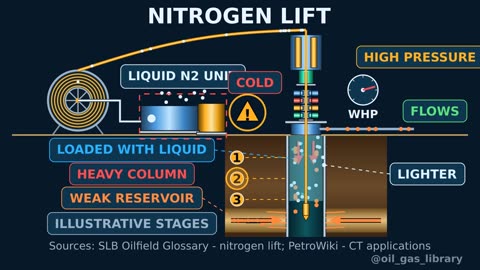
- 2Nitrogen Lift: Lightening the liquid column to initiate well flow
- 3Acidizing: Treating near-wellbore damage
- 4Milling with a motor in the BHA
Written Lesson
Why is CT so versatile?
Two features make CT a tool for many operations: we can pump through it while moving in the well, and this can be done on a live well without killing it. Thus, we can deliver the right fluid to the right depth accurately, whether it's water for cleanout, nitrogen to lighten the column, or acid to treat the formation.
Cleanout
Sand and scale can accumulate at the bottom of the well or inside the Tubing, covering perforations and choking production. We run CT with a jetting nozzle and pump fluid that carries sand to the surface through the Annulus between the CT and Tubing. The key condition is that the annular rising velocity must exceed the particle settling velocity by a sufficient margin; otherwise, sand accumulates above the BHA and may stick the tubing.
Annular capacity (bbl/ft) = (ID² − OD²) ÷ 1,029.4
Annular velocity (ft/min) = Rate (bbl/min) ÷ Annular capacity (bbl/ft)
Worked example: CT with an OD of 1.75 in inside tubing of 3-1/2 in with an ID of 2.992 in. Annular capacity: Annulus (2.992² − 1.75²) ÷ 1,029.4 = (8.952 − 3.063) ÷ 1,029.4 ≈ 0.00572 bbl/ft. Pumping at 2.0 bbl/min gives an annular (uphole) velocity of 2.0 ÷ 0.00572 ≈ 350 ft/min. In deviated and horizontal sections, lifting sand is harder because it settles on the low side, so we need a higher velocity, gelled fluids, or frequent short wiper trips.
Cleanout progresses in stages: penetrate part of the sand, pull back slightly and circulate until sand clears, then return. Monitoring surface sand returns, circulating pressure, and weight during the job tells us if the hole is clean.
Nitrogen Kickoff
After completion or intervention, the well may be filled with fluid too heavy for the reservoir to lift, preventing flow. We run CT and pump nitrogen, which lightens the liquid column and lowers bottomhole pressure below reservoir pressure, allowing the well to flow naturally.
Calculated Example: A well with 8,000 ft TVD filled with 8.6 ppg brine, giving a hydrostatic pressure of 0.052 × 8.6 × 8,000 ≈ 3,578 psi, while reservoir pressure is only 3,000 psi. The well won't flow with a full column. Reducing bottomhole pressure below 3,000 psi by displacing part of the fluid and lightening the rest with nitrogen will initiate flow, keeping the change gradual to avoid sudden Drawdown that could move sand.
Nitrogen is inert and non-flammable; it is pumped from a special unit that converts it from liquid to gas, and its volume is measured in standard cubic feet (scf).
Acidizing
Used to remove near-wellbore damage, such as carbonate scale or fines in the pores. The advantage of CT here is placing acid directly across the target zone, and it can be moved during pumping to distribute acid along the interval, minimizing Tubing exposure to acid. Corrosion inhibitors are added, and it must be noted that acid damages the tubing itself and accelerates fatigue, requiring a flush after the job.
Scale Removal and Milling
Hard scale like calcium carbonate and barium sulfate, or old plugs and excess cement, cannot be removed by washing alone. We use a mud motor to drive a Mill at the bottom of the BHA. Milling success depends on proper weight on bit, a flow rate matching the motor, and good cleanout to remove milled cuttings.
Other Operations
- Setting and retrieving Plugs and Packers, especially in highly deviated wells.
- Logging and perforating in horizontal wells where Wireline cannot reach by gravity.
- Fishing for tools stuck in the wellbore.
- Precise cement placement for zone isolation or well abandonment (Plug and Abandonment).
- Hydraulic fracturing via CT in multi-stage operations.
What determines the success of the operation?
Before any operation, a Tubing Forces analysis is performed to determine reachability to target depth, available overpull, pressure limits, and required annular velocity. All these are monitored during the job. Everything is recorded because the tubing carries its history to the next operation.
Summary
- The ability to pump while moving in a live well is the secret to CT versatility.
- In cleanouts, annular velocity must exceed sand settling velocity, calculated from the Annulus capacity.
- Nitrogen lightens the column to initiate flow, and acid removes near-wellbore damage.
- Milling with a motor removes hard scale and plugs.
The figures and examples in this lesson are for educational purposes. On the job, always follow your company procedures and accredited training center instructions.
Test Yourself
Lesson Glossary
Removing sand and scale from the well by circulation through the CT.
Fluid velocity in the Annulus, which must exceed the particle settling velocity.
Pulling and running the tubing while circulating to remove accumulated sand.
Lightening the liquid column with nitrogen to initiate well flow.
A cutting tool driven by a motor to grind scale and plugs.
Continuous length of steel tubing spooled on a reel, deployed into live wells without making pipe connections.
Conduit through which produced fluids flow to the surface.