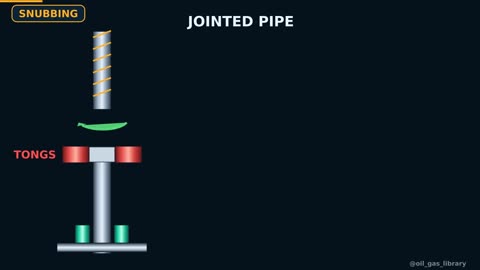
Snubbing: how to run pipe into a live well without killing it?
Lesson Summary
Running and pulling jointed pipe under well pressure. We explore the equipment, forces, Pipe-light and Pipe-heavy conditions, and sealing between Rams.
This lesson is part of the Well Intervention track, with a duration of 10:05 minutes. Watch the video first, then review the key points and test your understanding with the questions below.
Key Points
- 1Pipe-light: Well force is greater than pipe weight, requiring downward force.
- 2Maximum Force = Well Force + Friction
- 3Stripping between Ram and Ram with chamber balancing and venting.
- 4Buckling limits determine the allowable snubbing force.
Written Lesson
What is Snubbing?
The Snubbing is the process of running or pulling pipe from a well open to formation pressure without killing the well with heavy fluid. The pipes used are Jointed Pipe, pushed by hydraulic force into the well against its pressure; this is why the unit is also known as a Hydraulic Workover Unit (HWU).
The concept has evolved over time into modern hydraulic units. It is one of the most daring intervention operations, as it deals with a live well under pressure.
Why not just kill the well?
Killing the well with a heavy Kill Fluid is the standard method, but it can damage the reservoir: fluid leaks into the formation, plugging pores and reducing future production. Some wells cannot be killed at all, either because the formation is weak and swallows the fluid, or because its pressure exceeds what can be easily balanced.
Snubbing is used when the cost of reservoir damage or the risk of killing the well is higher than the risk of working on a live well. One of its benefits is also saving time, as there is no need to kill the well and then restart production.
Unit Components
- Hydraulic Jacks: Cylinders that push the pipe down and pull it up with a calculated force.
- Slips: Stationary and traveling slips that alternate gripping the pipe to keep it secure during movement.
- BOP Stack: Holds pressure and seals around the pipe, including two sets of Rams for stripping.
- Workbasket and auxiliary equipment: Work platform, equalization valves and lines, and pump controls.
Units are classified into stand-alone units that can be transported and rigged up independently, and rig-assist units mounted on a drilling rig or supported by a crane.
Forces: Pipe-light and Pipe-heavy
The key to understanding the process is the balance between two forces: the well pressure force pushing the pipe up, and the pipe weight pulling it down. Well force = Pressure × Cross-sectional area of the pipe exterior.
Calculated example (ignoring buoyancy and friction for simplicity): Wellhead pressure 3,000 psi, pipe OD 2-7/8 inches, cross-sectional area (π/4) × 2.875² ≈ 6.49 in². Well force ≈ 3,000 × 6.49 ≈ 19,475 lbf. If pipe weight is 6.5 lb/ft, the Balance Point is at 19,475 ÷ 6.5 ≈ 3,000 ft of pipe in the well.
Before this point, the condition is Pipe-light, meaning well force is greater than pipe weight and tries to eject it; we need hydraulic force to push it down (this is true Snubbing). After the balance point, pipe weight becomes greater, the condition is Pipe-heavy, and the operation shifts to standard Stripping mode.
One of the hazards here is Buckling: when pushing a long unsupported pipe, it may bend at a certain force. Therefore, buckling limits determine the allowable snubbing force and the length of unsupported pipe.
Stripping Ram-to-Ram
A pipe Coupling or any part wider than the pipe body cannot pass through a closed Ram. Therefore, we use Stripping Ram-to-Ram (Ram-to-Ram) during running: the upper Ram is closed holding well pressure. When the coupling reaches it, we close the lower Ram, vent the trapped pressure between them, then open the upper one without differential pressure and lower the pipe until the coupling is between the Rams. Then, we close the upper ram on the pipe body, equalize the chamber pressure with the well pressure, open the lower ram, and continue running. When pulling, the sequence is reversed. Any error in venting or equalizing can damage the Ram elements, so these steps are performed precisely and under supervision.
Suitable Operations and Comparison
Snubbing is used for Workover on live wells, cleanouts, pulling pipe, installing completion equipment, and Underbalanced drilling operations. Comparison with other methods:
- Coiled Tubing: Faster and runs without joints, but has limited diameter, lower stiffness, and cannot be rotated from the surface.
- Conventional Workover Rig: Handles heavy loads but requires killing the well.
- Snubbing: Uses jointed pipe that can be rotated and works on live wells, but is slower and carries higher risk.
Safety
Working on a live well increases the risk level, so crews adhere to strict rules: testing the BOP before starting, monitoring snubbing force and buckling, keeping the danger zone clear, and training the crew on emergency plans for pipe or joint failure. The operation is executed according to a written and approved program with no improvisation.
The numbers and examples in this lesson are educational; real limits vary by equipment and company standards.
Test Yourself
Lesson Glossary
Increase in bottomhole pressure caused by running the drill string too quickly.
Running and pulling jointed pipe under well pressure.