Coiled Tubing 5: The BHA and Check Valves
Lesson Summary
What we hang at the end of the pipe: The connector, check valves, disconnect point, and tools depending on the operation.
This lesson is part of the Well Intervention track, with a duration of 10:01 minutes. Watch the video first, review the key points, and test your understanding with the quiz below.
Key Points
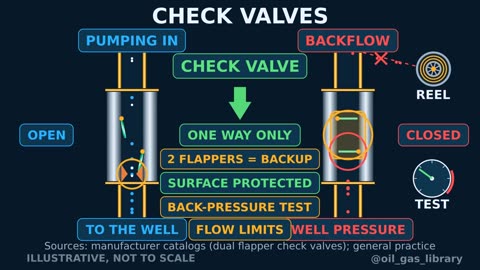
- 1Check valves (Check Valves) prevent well fluids from returning inside the pipe
- 2They are usually installed with two flappers as a double barrier
- 3The disconnect point allows leaving a stuck tool and retrieving the pipe
- 4The BHA is selected based on the operation
Written Lesson
What is the BHA in CT?
The BHA (Bottom Hole Assembly) is the set of tools mounted at the end of the pipe. The final tool varies by operation, but the upper part of the BHA is similar in most operations because its functions are essential for safety: connecting tools to the pipe, preventing well fluids from returning inside the pipe, and allowing disconnection if tools become stuck.
Example of a common arrangement from top to bottom: CT connector, then check valves, then hydraulic disconnect, then a swivel or other tools, and finally the work tool such as a jetting nozzle or a motor with a milling tool.
CT Connector (CT Connector)
Since the pipe has no threads at its end, we need a connector to attach to it. Types include: the Grapple connector fixed by external gripping teeth, the Dimple connector pressed into the pipe wall, and the Roll-on connector rolled into the pipe. After installation, the connector is pull-tested and pressure-tested before RIH, as its failure means leaving the BHA in the well.
Check Valves
They allow flow from the tubing to the well only, preventing backflow. A design with two consecutive Flapper valves in one unit (Dual Flapper Check Valve) is commonly used, providing two independent barriers inside the tubing.
Why are they important? If the tubing is punctured or parted above the Stripper, or if the reel's swivel joint leaks, well fluids would find an open path to the surface through the tubing bore. The Check Valves shut this path.
This comes at a cost: Reverse Circulation is impossible through them, and well pressure cannot be read directly via the tubing. In special operations requiring this, a decision is made based on formal risk assessment and alternative barriers.
Hydraulic Disconnect
If the tool gets stuck in the well and cannot be freed, we don't want to cut the tubing. The disconnect sub allows leaving the lower part of the BHA in the well and pulling the tubing out intact. The most common method: drop a ball into the tubing at surface, pump it until it seats in the sub, then increase pressure to shear the Shear Pins and disconnect. A standard Fishing Neck remains on the fish to facilitate later recovery.
The ball must pass through everything above the seat; therefore, care must be taken that all tools above the disconnect have an ID larger than the ball, and tools operated by smaller balls are placed below it.
Calculated Example: How long does the ball take to arrive? The tubing on the reel is 15,000 ft long with an internal capacity of 0.00213 bbl/ft, so its volume is ≈ 32 bbl. Pumping at 1.0 bbl/min, the ball needs at least 32 minutes to reach the seat, and potentially more as it lags in the first wraps on the reel. We record the pumped volume after dropping the ball, expect a pressure rise near the calculated volume, then reduce the pump rate before arrival to avoid a hard impact on the seat.
Tools by Operation
- Cleanout: Jetting Nozzle with downward and side-facing ports.
- Milling: Mud Motor with a Mill to remove hard scale or plugs.
- Fishing: Grappling tools like an Overshot, with Jars to deliver impacts.
- Logging: In horizontal wells, CT conveys logging tools and may contain an internal electric cable.
- Acidizing: Special acid-resistant nozzles or diversion tools to distribute acid across zones.
- Circulating Sub: Opens a side port to increase circulation rate above a flow-restricting tool.
Reviewing the BHA before Running In Hole
A BHA diagram is drawn showing each component's length, OD, ID, maximum tension and pressure, and fishing neck type. This diagram is essential if tools get stuck, as the fishing team needs to know exactly what was left in the hole and how to catch it.
Summary
- The upper part of the BHA is nearly constant: connector, then check valves, then disconnect sub.
- Check valves provide a dual barrier inside the tubing and prevent reverse circulation.
- The disconnect sub is operated by a ball, and its arrival time is calculated from the total tubing volume.
- The BHA diagram is essential for any subsequent fishing operation.
The figures and examples in this lesson are for educational purposes. On the job, always follow your company procedures and accredited training center instructions.
Test Yourself
Lesson Glossary
The tools assembled at the end of the tubing string.
A component fixed to the end of the CT to connect it to the tools.
Two consecutive valves preventing well fluids from rising inside the tubing.
A sub that disconnects by dropping a ball and increasing pressure to leave a stuck tool.
A standard profile at the top of a tool that allows it to be caught for recovery.
Continuous length of steel tubing spooled on a reel, deployed into live wells without making pipe connections.
Conduit through which produced fluids flow to the surface.