Coiled Tubing 3: How to Contain a Live Well? Stripper and Quad BOP
Lesson Summary
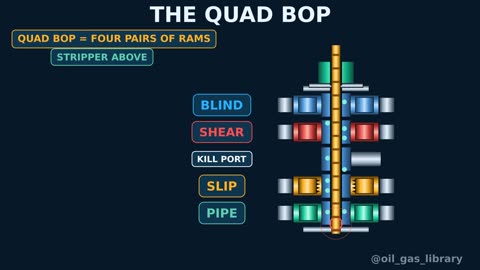
Barriers that prevent well pressure from escaping around the pipe: The Stripper, then the Quad BOP with its four pairs of Rams.
This lesson is part of the Well Intervention track, with a duration of 10:01 minutes. Watch the video first, review the key points, and test your understanding with the quiz below.
Key Points
- 1The Stripper seals around the pipe during movement
- 2The Quad BOP: Blind, Shear, Slip, Pipe
- 3Slip Rams hold the pipe, and Pipe Rams seal around it
- 4The Shear cuts the pipe in an emergency
Written Lesson
The Problem: Pipe Moving in a Well Under Pressure
In CT operations, the well is often live, meaning there is surface pressure. The pipe must continuously enter and exit without well fluids leaking around it. This is the role of pressure control equipment, which works on the barrier principle: there must always be one active barrier and another ready to be closed if the first fails.
The Stripper: The First Barrier During Movement
The Stripper, sometimes called a Stuffing Box, is mounted directly below the injector head. It contains packing elements (Packers) made of rubber or polymer materials that are hydraulically compressed around the pipe, sealing the annulus while allowing it to pass. Its energizing pressure is adjusted based on well pressure: too little pressure causes leaks, while excessive pressure increases friction and wears elements quickly. Common designs allow changing elements through a Side-Door after closing the BOP. In high-pressure wells, a double Stripper or a second backup Stripper is sometimes used.
The Quad BOP: Four Functions in One Unit
Below the Stripper, the CT-specific BOP is installed. The classic design is a Quad BOP, arranged from top to bottom as follows:
- Blind Rams: Seal the well when no pipe is present.
- Shear Rams: Cut the pipe in an emergency.
- Slip Rams: Toothed dies that grip the pipe and prevent it from moving up or down.
- Pipe Rams: Seal around the pipe and prevent leakage.
Between the Shear Rams and Slip Rams, there is usually a lateral Kill Port allowing pumping into the well. Each pair of Rams has an Equalizing Valve to balance pressure above and below before opening, as opening a Ram under high differential pressure could damage it.
In newer designs, two functions are integrated into each Ram, such as Shear/Seal and Pipe/Slip, in what is called a Combi BOP, reducing the stack height.
Barriers Inside the Pipe
The Stripper and BOP seal the space around the pipe, but what about the inside? This is where Check Valves in the BHA come in, usually doubled. They prevent well fluids from rising inside the pipe to the surface if the pipe is punctured or severed above the Stripper. This is the subject of Part 5 of the series.
Well Pressure Force on the Pipe
Well pressure acts on the external cross-sectional area of the pipe at the Stripper, pushing it outward. At shallow depths, the pipe weight in the well is low, so this force is greater than the weight, and the pipe is said to be Pipe Light. Here, the injector head must push the pipe inward, and any chain slippage could eject the pipe from the well.
F (lbf) = WHP (psi) × (π ÷ 4) × OD² (in)
Calculated Example: A 1.75 in pipe in a well with 3,000 psi wellhead pressure. Area (π ÷ 4) × 1.75² = 0.7854 × 3.0625 ≈ 2.405 in², and force 3,000 × 2.405 ≈ 7,216 lbf upward, plus Stripper friction. Pipe weight is about 2.31 lb/ft; if the well is gas-filled (low buoyancy), the pipe remains light until a depth of approximately 7,216 ÷ 2.31 ≈ 3,120 ft. Until that depth, the injector head works in Snubbing mode, then switches to holding mode after the balance point.
Emergency Shut-in Sequence
The procedure varies by situation and company instructions, but the general logic is: If the Stripper leaks, stop movement and close Slip Rams then Pipe Rams to isolate the well around the pipe, then repair or change the element. If that is insufficient, or if there is a leak inside the pipe with check valve failure, cut the pipe with Shear Rams and then close the Blind Rams. Cutting is a last-resort decision because it leaves the pipe and tools in the well.
Pre-job Testing
Before opening the well, the Stripper, BOP, and lines are pressure tested at low then high pressure according to the approved program, and each Ram is functionally tested. Each person's emergency responsibility is reviewed with the crew before starting.
Summary
- The Stripper is the primary barrier around the moving pipe, and the BOP is the backup barrier.
- The Quad BOP from top: Blind, then Shear, then Slip, then Pipe, with a lateral kill port.
- Check valves are the barrier inside the pipe.
- Pressure force on the pipe can make it light near the surface, requiring the injector head to snub.
The figures and examples in this lesson are for educational purposes. On the job, always follow your company procedures and accredited training center instructions.
Test Yourself
Lesson Glossary
A BOP unit for CT containing Blind, Shear, Slip, and Pipe Rams.
Rams with teeth that grip the pipe and prevent its movement.
A valve that balances pressure on both sides of the Ram before opening.
A condition where the well pressure force is greater than the pipe weight.
Wellhead valve assembly used to shut in the well in the event of a kick.
Shear through the pipe and fully shut in the wellbore.
Continuous length of steel tubing spooled on a reel, deployed into live wells without making pipe connections.
Seals around the pipe during movement to contain well pressure.
Conduit through which produced fluids flow to the surface.