Slickline in detail: tools and fishing
Lesson Summary
Solid thin steel wire without an electric cable. We learn about sizes, safe pull limit, the Lubricator, Jars, and fishing operations.
This lesson is part of the Well Intervention track and is 9:18 minutes long. Watch the video first, then review the key points and test your understanding with the questions below.
Key Points
- 1Slickline does not transmit electricity or data
- 2No pushing or rotating: all force comes from Jarring
- 3The Lubricator allows tools to be introduced under pressure
- 4The Gauge Cutter is run before any operation to check the tubing
Written Lesson
What is Slickline?
The Slickline is a solid, thin, and smooth steel wire wound on a drum in a small unit, used to lower various tools into the well. It carries no electricity or data, making it the simplest, fastest, and cheapest type of Wireline. Common sizes are 0.092, 0.108, and 0.125 in, with larger sizes available for heavy-duty work. The steel grade is selected based on the well; wells with H2S require alloys resistant to embrittlement.
How do we work without pushing or rotating?
The wire cannot be pushed, as it would bend, and it cannot be rotated. All we can do is lower by gravity and pull on the wire. Therefore, the toolstring is built to generate force from its weight and impacts:
- Rope socket (Rope Socket): connects the wire to the tools.
- Weight bars (Stem): provide the string with enough weight to descend against well pressure and Stuffing Box friction, and provide mass for the impact.
- The Jars: a sliding joint that stops suddenly, converting wire movement into an upward or downward shock. Types include mechanical (Spang Jar), hydraulic (providing a strong upward shock after a delay), and spring jars.
- Knuckle joint (Knuckle Joint): provides flexibility to the toolstring in deviated wells.
- Service tool: Running Tool, Pulling Tool, measurement tool, or scratching tool.
The Lubricator and Pressure Equipment
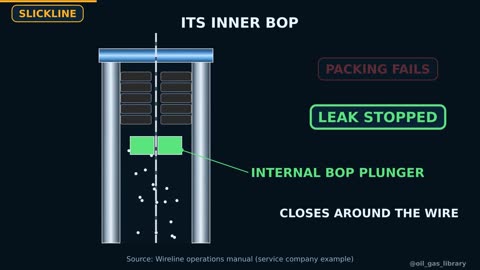
To run tools into a live well, we install a Wireline valve (Wireline Valve or BOP) above the Swab Valve on the wellhead to seal on the wire, followed by the Lubricator—long tubing sections holding the entire tool string—and the Stuffing Box at the top, allowing the wire to pass tightly through packing elements. Steps: place tools inside the Lubricator with the well shut in, pressure-equalize and open the Swab Valve to run in. When pulling out, retrieve tools into the Lubricator, close the valve, and bleed off pressure before disconnecting.
Well pressure acts on the wire cross-section in the Stuffing Box, pushing it out; therefore, we need sufficient weight in the toolstring.
Push-out force (lbf) = WHP (psi) × (π ÷ 4) × d² (in)
Calculated Example: A 0.108 in wire in a well with 3,000 psi pressure. Area 0.7854 × 0.108² ≈ 0.00916 in², and force 3,000 × 0.00916 ≈ 27.5 lbf. Adding Stuffing Box friction, the string needs a weight significantly higher than this to descend.
Safe Working Load
The wire has a breaking strength (Breaking Strength) specified by the manufacturer for each size and type. We do not work at this limit, but at a percentage of it defined by company procedures. It is important to remember that the surface tension reading includes the wire's own weight and the tool weight.
Wire weight (lb/ft) ≈ 3.4 × (π ÷ 4) × d²
Calculated Example: A 0.108 in wire weighs ≈ 3.4 × 0.00916 ≈ 0.031 lb/ft, so 10,000 ft weighs about 311 lb. Assume the safe working limit for this wire is 900 lbf and the tool weight is 150 lb. The additional pull available for Jarring at the tool is only ≈ 900 − 311 − 150 ≈ 439 lbf. This is why Slickline relies on repeated impacts rather than massive tension. Numbers here are for illustration; actual limits come from the specific wire data sheet.
Common Operations
- Checking tubing with a Gauge Cutter: The first run in most programs, to ensure the path is clear, the diameter allows tool passage, and to scrape light deposits.
- Setting and retrieving plugs and tools in Nipples.
- Changing gas lift valves in Side Pocket Mandrels.
- Running and pulling wireline-retrievable subsurface safety valves (SSSV).
- Taking pressure and temperature measurements with Memory Gauges.
- Bailing sand with a Bailer, and opening/closing Sliding Sleeves.
Fishing with Slickline
If a tool is stuck or the wire breaks, we start by identifying what is in the well before attempting retrieval. An Impression Block, a lead-bottomed tool, is lowered and struck against the top of the fish to imprint its shape. Then, we choose the tool: Overshot or Pulling Tool for a fishing neck, or tools to catch broken wire like a Wire Grab. The golden rule: never lower a tool you don't know how to fish if it gets stuck too.
Summary
- The Slickline is a solid wire that transmits no electricity or data; it is the simplest and fastest.
- No pushing or rotating: force comes from tool weight and Jarring.
- The Lubricator, Stuffing Box, and Wireline Valve allow working on a live well.
- Available pull at the tool = Safe Working Load − wire weight − tool weight.
The figures and examples in this lesson are for educational purposes. On the job, always follow your company procedures and accredited training center instructions.
Test Yourself
Lesson Glossary
Heavy bars that provide weight and mass to the tool string for jarring impacts.
A tool that generates an upward or downward shock to release or operate tools.
A component at the top of the Lubricator that seals around the wire while it is moving.
A tool with a lead base that takes an impression of the shape of the fish or object stuck in the well.
Solid metal wire without electrical conductors used to run mechanical tools.
Pressure-retaining tubulars mounted on the wellhead to introduce tools under pressure.