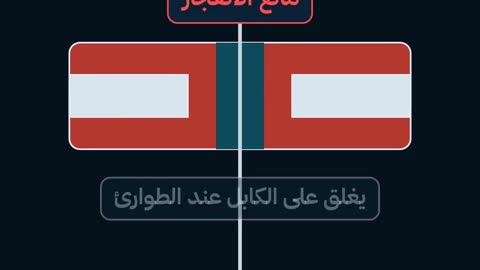
What is E-line and how does it work inside the well?
Lesson Summary
Armored cable with electrical conductors transmitting power and data, used for logging, perforating, and depth correlation.
This lesson is part of the Well Intervention track and is 3:01 minutes long. Watch the video first, then review the key points and test your understanding with the questions below.
Key Points
- 1Transmits power and real-time data
- 2Used for logging and perforating
- 3Sealed with a suitable pressure head and packing
Written Lesson
What is the difference between E-line and Slickline?
The E-line, or Electric Line, is an armored cable with two layers of steel wires wrapped around one or more insulated electrical conductors. The armor provides tensile strength, while the conductors transmit power to the tools and return data to the surface in real-time. In contrast, Slickline is a solid wire that does not transmit data; its tools record data to memory to be read after retrieval. Therefore, E-line is used when immediate decisions are needed during the job: logging, perforating, and precise depth determination.
Cable Types
- Mono-conductor (Mono-conductor): common in producing well operations and perforating, featuring a smaller diameter.
- Multi-conductor: usually seven conductors, used for open-hole logging tools that require higher power and data transfer.
Sizes and breaking strength vary by manufacturer. Every cable has a Weak Point designed at the cable head, so the cable disconnects from the tools there if they get stuck, rather than breaking at an unknown point in the well.
Pressure Control on Braided Cable
The cable surface is not smooth because it consists of wrapped wires; therefore, a standard stuffing box like the one used for Slickline is insufficient. The solution is the Grease Injection Head: a set of Flow Tubes with an internal diameter slightly larger than the cable, into which viscous grease is pumped at a pressure higher than the well pressure. This fills the gaps between the wires and creates a dynamic seal. Above it, there is usually a hydraulically operated Packoff for use when needed, and below the Lubricator is the Wireline valve (BOP) that closes on the cable. More Flow Tubes are required as well pressure increases.
Logging (Logging)
The cable powers the tools and carries their readings to the surface unit. Common cased-hole logs include: Gamma Ray (GR) and Casing Collar Locator (CCL) for depth determination, Cement Bond Log (CBL), Production Logging Tool (PLT), hydrocarbon saturation logs behind casing, and casing corrosion inspections. Readings are seen during logging, allowing an unclear section to be repeated immediately.
Perforating (Perforating)
After cementing the casing, holes are needed to connect the well to the formation. Perforating guns with shaped charges are lowered, depth is determined using the CCL and GR, and an electrical signal is sent through the cable to fire them. Strict explosives management is applied, including radio silence, grounding, and surface gun arming procedures.
Example of Depth Correlation Before Perforating
The surface depth counter is not enough because the cable stretches and the counter can slip. Therefore, the CCL and GR log from the current run is matched with a Reference Log.
Calculation Example: On the reference log, a casing collar is at 9,870 ft. In our run, the same collar appears at 9,862 ft, meaning our counter reads 8 ft shallow; we correct the depth by adding 8 ft. The top shot in the gun is 6.5 ft below the CCL. To place the top shot at 9,900 ft (reference depth), the CCL must be at 9,900 − 6.5 = 9,893.5 ft reference depth, which is 9,893.5 − 8 = 9,885.5 ft on the counter reading before correction. After correction, we set the counter and move to 9,893.5 ft then fire.
Other E-line Operations
- Setting plugs and packers using a setting tool activated by a slow-burn charge or electrically.
- Cutting stuck pipe chemically or with cutting charges, after determining the stuck point with a Free Point tool.
- In horizontal wells: an electric Tractor powered through the cable pushes the tools where gravity is insufficient.
Summary
- E-line transmits power and data in real-time, while Slickline does not.
- Braided cable is sealed by grease injection in Flow Tubes, not by a standard stuffing box.
- It is used for logging, perforating, setting plugs, and cutting.
- Depth correlation relies on matching CCL and GR with a reference log.
The figures and examples in this lesson are for educational purposes. On the job, always follow your company procedures and accredited training center instructions.
Test Yourself
Lesson Glossary
Cable containing electrical conductors inside two layers of steel wires.
Pressure control equipment that seals around braided cable using grease.
Precision tubes through which the cable passes and grease is injected.
A component designed to disconnect at the cable head if tools become stuck.
An explosive charge that creates a high-velocity jet to penetrate casing, cement, and rock.
Solid metal wire without electrical conductors used to run mechanical tools.
Armored cable transmitting power and data for logging and perforating operations.