Coiled Tubing 4: Fatigue and Pipe Life
Lesson Summary
Every time the pipe bends over the reel and gooseneck, it loses part of its life. Learn about grades, fatigue limits, and when to retire the pipe.
This lesson is part of the Well Intervention track, with a duration of 10:01 minutes. Watch the video first, review the key points, and test your understanding with the quiz below.
Key Points
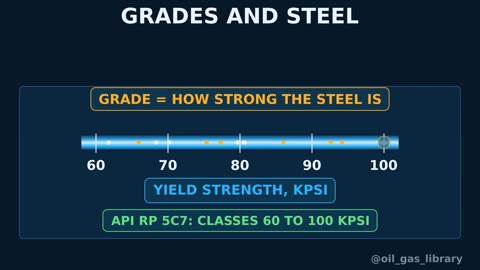
- 1Grade expresses yield strength in kpsi
- 2Bending beyond the elastic limit causes cumulative fatigue
- 3Internal pressure during bending accelerates fatigue
- 4Life is tracked by software recording every trip
Written Lesson
Fatigue: Why Does the Pipe Wear Out?
Steel can withstand many repeated loads if they remain within the elastic limit. However, CT is wound on a reel and passes over an arch, undergoing bending that exceeds the elastic limit—known as Plastic Bending—and is then straightened again upon entering the injector head. Each bend and straighten is a cycle that consumes part of the pipe's life, called Low-Cycle Fatigue. After a certain number of cycles, small cracks appear, which can turn into a pinhole or a parting of the pipe.
How Many Times Does the Pipe Bend in One Trip?
During RIH: It is straightened leaving the reel, bends over the gooseneck, and is straightened entering the injector head. During POOH, the same events repeat in reverse. This means every section of pipe passing over the arch undergoes several bending events in each full trip. However, damage is not uniform along the pipe: sections that stop at the arch during repeated operations, such as reciprocating in one place, fatigue much faster than others.
How Much Does Bending Exceed the Elastic Limit?
The Strain resulting from bending is approximately equal to the outer radius of the pipe divided by the radius of curvature.
Bending strain ≈ (OD ÷ 2) ÷ R
Yield strain ≈ Yield strength ÷ E, E ≈ 30,000,000 psi
Calculated Example: A 1.75 in diameter pipe on a 72 in radius arch: Strain ≈ 0.875 ÷ 72 ≈ 0.0122, or about 1.2%. An 80,000 psi grade pipe has a yield limit ≈ 80,000 ÷ 30,000,000 ≈ 0.0027, or about 0.27%. The actual strain is therefore more than four times the elastic limit. This is why CT fatigue is considered inevitable, and all we do is manage it. If the radius were smaller or the pipe diameter larger, strain would increase and life would decrease.
Grades (Grades)
The pipe grade is defined by the minimum yield strength in thousands of psi. A grade like CT-80 means a minimum yield strength of 80,000 psi, and there are higher grades like 90, 100, and 110. A higher grade withstands greater pressure and tension, but its response to fatigue and sour environments like H2S is affected by metallurgical composition; therefore, the pipe is chosen based on the well and not just by the highest grade.
What Accelerates Fatigue?
- Internal pressure during bending: High pressure inside the pipe while it is on the arch significantly reduces its life; therefore, we reduce pumping during repeated movements if possible.
- Small bending radius and large pipe diameter.
- Chemical corrosion from acids, H2S, and CO2, as well as scratches and gripper block marks.
- Welds: Relative points of weakness whose locations on the pipe must be known.
Notable Effects: Ballooning and Ovality
As cycles accumulate under internal pressure, the pipe diameter gradually increases (Ballooning), its wall thickness decreases, and it may lose its roundness, becoming oval (Ovality). An oval pipe may not be properly sealed by the Stripper or Pipe Rams; therefore, diameter and ovality are measured periodically.
How Do We Track Life?
Every trip is recorded by fatigue tracking software: depth, bending positions, and internal pressure during movement. The program divides the pipe into short sections and calculates the percentage of life consumed for each section. When a section approaches a retirement limit set by the company, that part is cut off or the entire pipe is retired. This decision does not rely on visual appearance, as fatigue cracks are usually not visible until it is too late.
Summary
- Every pass over the reel and arch is a plastic bend that consumes pipe life.
- Strain ≈ (OD ÷ 2) ÷ R, which is much higher than the elastic limit in common cases.
- Internal pressure during bending and corrosion accelerate fatigue.
- Life is tracked by software for each pipe section, not by visual inspection.
The figures and examples in this lesson are for educational purposes. On the job, always follow your company procedures and accredited training center instructions.
Test Yourself
Lesson Glossary
Damage resulting from a relatively small number of plastic bending cycles.
Bending that exceeds the elastic limit, leaving permanent deformation in the metal.
The ratio of elongation or compression in the metal to its original length.
Increase in the outer diameter of the pipe as fatigue cycles accumulate under pressure.
Loss of pipe roundness, affecting the seal around it.
Continuous length of steel tubing spooled on a reel, deployed into live wells without making pipe connections.
Conduit through which produced fluids flow to the surface.